
From a multi vendor estate to a single view
The information already exists, scattered across hundreds of devices that do not name the same things the same way. NacTrack cross references it and returns it in the only form operations can use: a chart, a filterable table, a colour code.
From a customer name to the port the service lands on
Every link is derived from something read off a device. The bottom row says what from.
DERIVED FROM
- Accountthe group
- Customerthe billed entity
- Servicewhat is sold
- Attachmentwhere it lands
- Devicethe box
- Sitethe place
Blast radius is this same chain walked backwards, which is why the two answers cannot contradict each other. Every link remembers where it came from, and a walk reports the weakest one it crossed.
Your customers, seen from your own network
The customer as the starting point
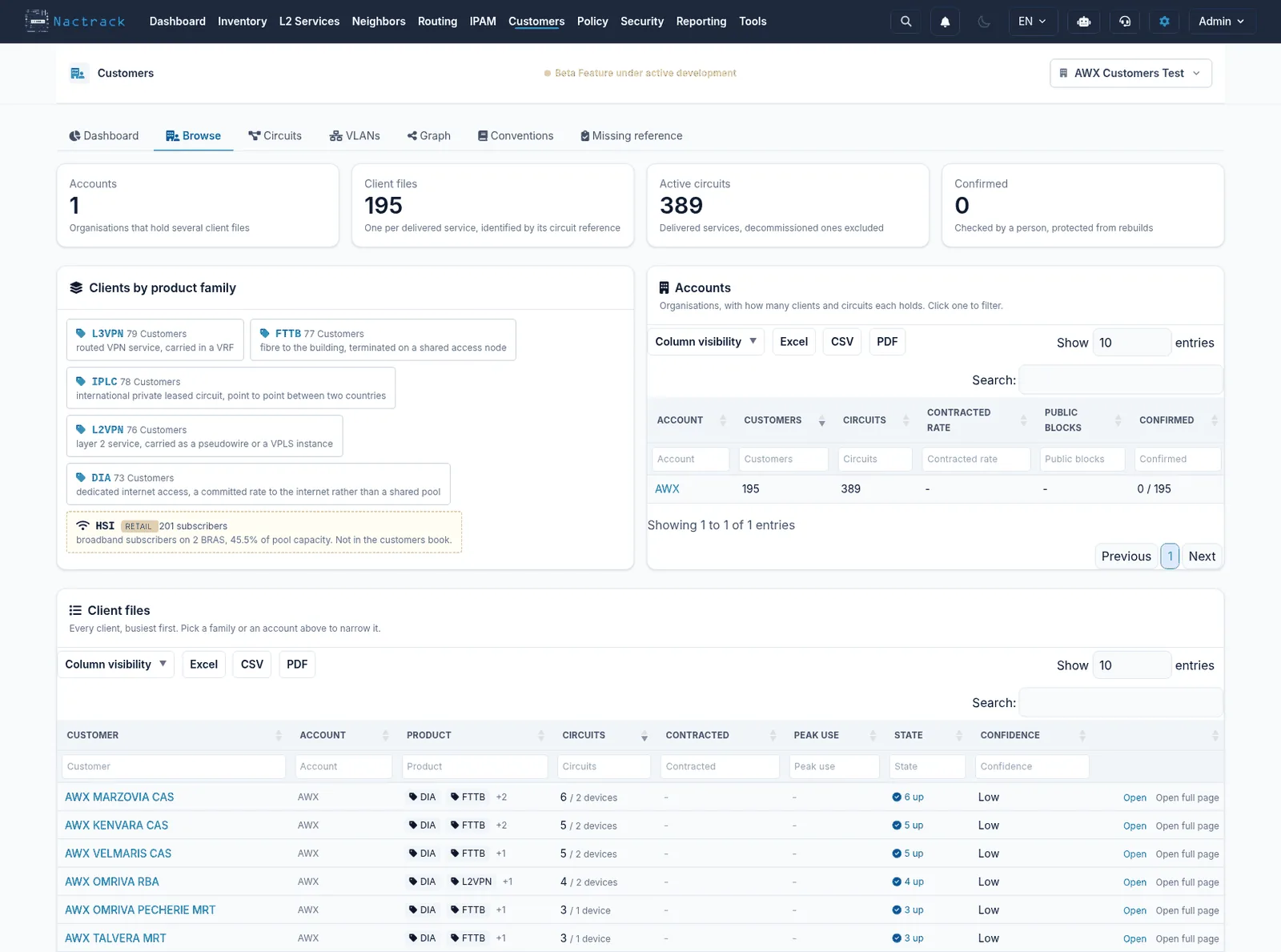
An account, its entities, their services, and for each service the device and port where it actually lands. Built from the customer outward, not the reverse.
Blast radius
This device goes down: who is cut off, and which services. The reverse question walks exactly the same path, so the two answers cannot contradict each other.
Shared failure domains
Knowing three hundred customers share one PE and a single customer shares another changes the priority. On a diagram the two look alike.
Provenance on every link
An interface description is weaker than a configuration, which is weaker than an observed state. Every path reports the weakest link it crossed.
Redundancy asserted, never guessed
Protection is only recorded where it was labelled. Two ports with one down is not redundancy, and the product refuses to claim it is.
Per entity isolation
One tenant per subsidiary or managed customer, with separate rights and no leakage between tenants.
What the product addresses at an operator
Core and edge
Core and provider edge routers, BGP, IS-IS and OSPF sessions, routes advertised on internet edge devices.
Transport services
MPLS and L2VPN circuits, xconnect, with the remote device and the state of each circuit.
Aggregation and access
VLAN continuity between sites, spanning tree, access ports, endpoints seen per site.
Multi generation estate
Old hardware is the least documented and the most fragile. It is also what SSH collection reaches without difficulty.
A dated statement for the regulator
A dated compliance and exposure report, produced from the real state rather than from a declaration.